About
In the past, I compared computational cost between Skfem(Scikit-fem) and Ngsolve. Without doing experiments, I had already known the superiority of Ngsolve in terms this point, but I was unsure how much difference there is between them. What I found is that Scikit-fem is not so compettive with Ngsolve, but not super bad.
But I felt like, I want to have other option for solving heavier tasks. For sure we can use Ngsolve, but C++ language is NOT user friendly. Even though we have Python interface to access Ngsolve, the flexibility is limited.
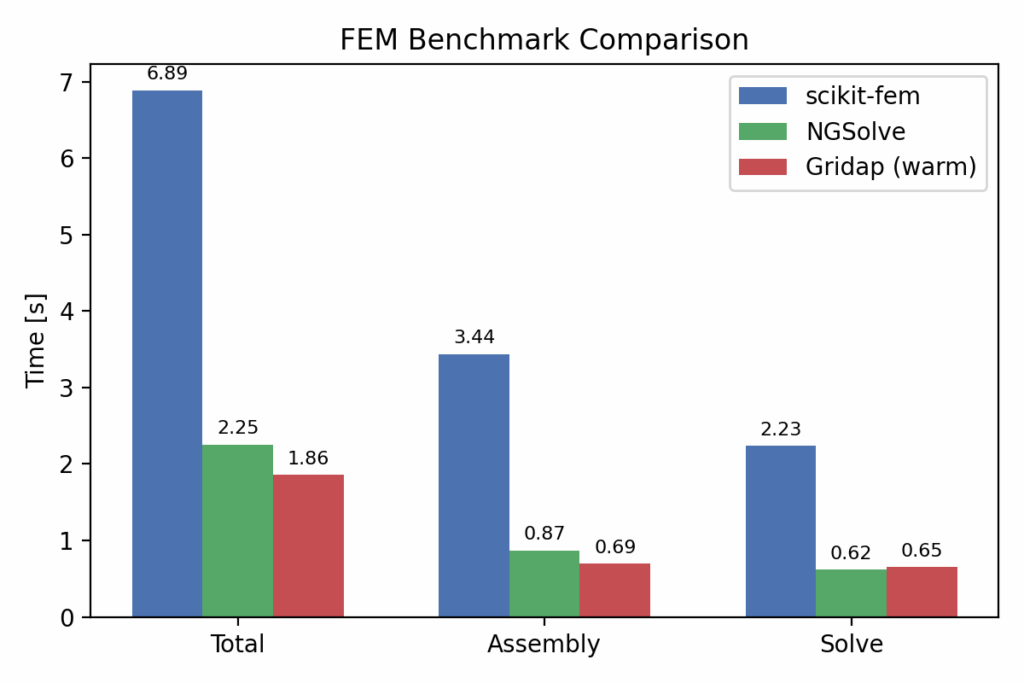
To compare with other option, “Gridap” which I introduced before, I implemented script that solve FEM on the same task.
Result
This is what I really wanted😊

However, it should be noted that these results correspond to a warm start (i.e., the second and subsequent runs). During the first execution, JIT compilation is performed, which consumes computational resources in addition to the actual numerical calculation. As a result, the first run takes a total of 51.6 seconds, whereas subsequent runs are accelerated to under 2 seconds.
While Gridap already offers advantages such as convenient handling of I/O and integration with various packages, this study shows that it also delivers excellent computational performance.
In addition, I had forgotten to mention that Gridap also supports automatic differentiation.
Implementation
import time
import numpy as np
import skfem as sk
def run_skfem(mesh_file: str):
from skfem.models.elasticity import lame_parameters
from skfem.models.elasticity import linear_elasticity
from skfem.helpers import dot
E, nu = 210e3, 0.3
traction_value = 1e-3
lam, mu = lame_parameters(E, nu)
t0_total = time.perf_counter()
mesh = sk.MeshTet.load(mesh_file)
basis = sk.Basis(mesh, sk.ElementVector(sk.ElementTetP1()))
print(f"mesh.p {mesh.p.shape}")
# @sk.BilinearForm
# def elasticity(u, v, w):
# eps_u, eps_v = sk.sym_grad(u), sk.sym_grad(v)
# return lam * sk.trace(eps_u) * sk.trace(eps_v) + 2 * mu * sk.ddot(eps_u, eps_v)
@sk.LinearForm
def traction(v, w):
return traction_value * dot(np.array([1, 0, 0]), v)
left = mesh.facets_satisfying(lambda x: np.isclose(x[0], 0))
right = mesh.facets_satisfying(lambda x: np.isclose(x[0], 1.0))
fixed = basis.get_dofs(facets=left).all()
print(f"fixed:{fixed.shape}")
fbasis = sk.FacetBasis(
mesh, sk.ElementVector(sk.ElementTetP1()), facets=right
)
# アセンブリ
t0 = time.perf_counter()
# K = sk.asm(elasticity, basis)
K = linear_elasticity(lam, mu).assemble(basis)
F = sk.asm(traction, fbasis)
t_asm = time.perf_counter() - t0
# Dirichlet条件 + 解く
K, F = sk.enforce(K, F, D=fixed)
t1 = time.perf_counter()
u = sk.solve(K, F)
t_solve = time.perf_counter() - t1
t_total = time.perf_counter() - t0_total
print(f"[scikit-fem] Total: {t_total:.3f}s | Assembly: {t_asm:.3f}s | Solve: {t_solve:.3f}s | max|u|={np.abs(u).max():.3e}")
return mesh.p.T, u.reshape(-1, 3), [t_total, t_asm, t_solve]
def run_ngsolve(mesh_file: str):
import time
import numpy as np
from ngsolve import (
Mesh, VectorH1, BilinearForm, LinearForm, GridFunction,
CoefficientFunction, grad, Trace, Id, InnerProduct,
dx, ds, x, IfPos,
)
from netgen.read_gmsh import ReadGmsh
# --- 材料・荷重パラメータ ---
E, nu = 210e3, 0.3
traction_value = 1e-3
lam = E * nu / ((1 + nu) * (1 - 2 * nu))
mu = E / (2 * (1 + nu))
t0_total = time.perf_counter()
# --- メッシュ読み込み (.msh) ---
ngmesh = ReadGmsh(mesh_file)
mesh = Mesh(ngmesh)
print(f"nv = {mesh.nv}")
# --- x のレンジを自動取得 ---
xs = [vtx.point[0] for vtx in mesh.vertices]
xmin, xmax = min(xs), max(xs)
print(f"x-range: [{xmin:.6g}, {xmax:.6g}]")
# Dirichlet は座標で後から指定するので、ここでは dirichlet="" は指定しない
fes = VectorH1(mesh, order=1)
u = fes.TrialFunction()
v = fes.TestFunction()
# --- 線形弾性の弱形式 ---
def eps(w):
return 0.5 * (grad(w) + grad(w).trans)
def sigma(w):
return lam * Trace(eps(w)) * Id(3) + 2 * mu * eps(w)
a = BilinearForm(fes, symmetric=True)
a += InnerProduct(sigma(u), grad(v)) * dx
# --- Neumann: x ≈ xmax の面だけに traction をかける ---
eps_coord = 1e-8 * max(1.0, abs(xmax - xmin)) # スケールに合わせて少しだけ幅を取る
# x > xmax - eps のとき 1、それ以外 0
indicator_right = IfPos(x - (xmax - eps_coord), 1.0, 0.0)
tvec = CoefficientFunction((traction_value, 0.0, 0.0))
f = LinearForm(fes)
# 「すべての境界 ds」に対して、x≃xmax のところだけ traction が効く
f += InnerProduct(indicator_right * tvec, v) * ds
# --- アセンブリ ---
t0 = time.perf_counter()
a.Assemble()
f.Assemble()
t_asm = time.perf_counter() - t0
print("||f|| =", f.vec.Norm()) # 荷重がちゃんと入っているか確認用
# --- GridFunction と FreeDofs(BitArray コピー) ---
gfu = GridFunction(fes)
freedofs0 = fes.FreeDofs() # BitArray
freedofs = type(freedofs0)(freedofs0) # 古い NGSolve 向けコピー
# --- Dirichlet: x ≈ xmin の頂点の DoF を拘束 & 0 固定 ---
for vtx in mesh.vertices:
if abs(vtx.point[0] - xmin) < eps_coord:
dnums = fes.GetDofNrs(vtx) # この頂点に対応する DoF 番号
for d in dnums:
freedofs[d] = False # 拘束
gfu.vec[d] = 0.0 # Dirichlet 値
# --- 解く ---
t1 = time.perf_counter()
gfu.vec.data = a.mat.Inverse(freedofs, inverse="sparsecholesky") * f.vec
t_solve = time.perf_counter() - t1
t_total = time.perf_counter() - t0_total
# --- 頂点座標と変位を numpy 配列に ---
coords = np.zeros((mesh.nv, 3))
u_vals = np.zeros((mesh.nv, 3))
for i, vtx in enumerate(mesh.vertices):
p = vtx.point
x0, y0, z0 = p[0], p[1], p[2]
coords[i, :] = (x0, y0, z0)
# MeshPoint を通して点評価
val = gfu(mesh(x0, y0, z0))
u_vals[i, :] = np.array(val)
print(
f"[NGSolve] Total: {t_total:.3f}s | "
f"Assembly: {t_asm:.3f}s | "
f"Solve: {t_solve:.3f}s | "
f"max|u|={np.max(np.abs(u_vals)):.3e}"
)
return coords, u_vals, [t_total, t_asm, t_solve]
def visualize(
skfem_times, ngsolve_times,
dst_path: str = "benchmark_comparison.jpg"
):
import matplotlib.pyplot as plt
import numpy as np
# データ(あなたの測定結果)
labels = ["Total", "Assembly", "Solve"]
x = np.arange(len(labels)) # X軸位置
width = 0.35 # 棒の幅
fig, ax = plt.subplots(figsize=(6, 4))
rects1 = ax.bar(x - width/2, skfem_times, width, label='scikit-fem', color='#4C72B0')
rects2 = ax.bar(x + width/2, ngsolve_times, width, label='ngsolve', color='#55A868')
# 軸ラベル・タイトル
ax.set_ylabel('Time [s]')
ax.set_title('FEM Benchmark Comparison')
ax.set_xticks(x)
ax.set_xticklabels(labels)
ax.legend()
# 各棒に値を表示
def autolabel(rects):
for rect in rects:
height = rect.get_height()
ax.annotate(f'{height:.2f}',
xy=(rect.get_x() + rect.get_width() / 2, height),
xytext=(0, 3),
textcoords="offset points",
ha='center', va='bottom', fontsize=9)
autolabel(rects1)
autolabel(rects2)
fig.tight_layout()
plt.savefig(dst_path, dpi=200)
# plt.show()
print("✅ Saved: benchmark_comparison.png")
def compare_displacements(coords1, u1, coords2, u2, tol=1e-8):
# 両メッシュが一致する前提
assert np.allclose(coords1, coords2, atol=tol)
diff = u1 - u2
abs_err = np.linalg.norm(diff, axis=1)
l2_err = np.linalg.norm(abs_err)
rel_err = l2_err / np.linalg.norm(np.linalg.norm(u1, axis=1))
max_err = np.max(abs_err)
print(f"‣ L2 error = {l2_err:.3e}")
print(f"‣ Relative L2 error = {rel_err:.3e}")
print(f"‣ Max abs error = {max_err:.3e}")
if __name__ == "__main__":
msh = "tension_bar.msh" # Gmshで生成済みメッシュ
print("run_skfem")
skfem_coords, skfem_disp, skfem_times = run_skfem(msh)
print("run_ngsolve")
ngsolve_coords, ngsolve_disp, ngsolve_times = run_ngsolve(msh)
tT_s, tA_s, tS_s = skfem_times
tT_m, tA_m, tS_m = ngsolve_times
print("skfem max|u| =", np.abs(skfem_disp).max())
print("ngsolve max|u| =", np.abs(ngsolve_disp).max())
print("ratio (skfem/ngsolve) ≈", np.abs(skfem_disp).max() / np.abs(ngsolve_disp).max())
compare_displacements(skfem_coords, skfem_disp, ngsolve_coords, ngsolve_disp)
print("\n=== Benchmark Summary ===")
print(f"scikit-fem: Total {tT_s:.3f}s | Assembly {tA_s:.3f}s | Solve {tS_s:.3f}s")
print(f"ngsolve: Total {tT_m:.3f}s | Assembly {tA_m:.3f}s | Solve {tS_m:.3f}s")
visualize(
skfem_times, ngsolve_times,
)