
The structural problem
Creating a system similar to Zillow in Japan is particularly difficult due to structural issues in the real estate data ecosystem. Zillow provides comprehensive property data, historical transaction records, price estimates, and map-based analytics by aggregating large amounts of open and standardized data. However, the situation in Japan is very different.
First, real estate transaction data in Japan is not fully open or centralized. Much of the detailed property listing data is stored in closed systems operated by the real estate industry, most notably REINS. REINS is accessible only to licensed real estate agents and brokers, which means developers and startups cannot freely access the core listing data needed to build a comprehensive consumer platform.
Second, public datasets are fragmented and incomplete. Government datasets such as land price surveys or transaction price information exist, but they typically provide limited attributes and low spatial resolution. They also lack key information such as detailed building conditions, listing history, photos, agent information, and real-time market activity. Because of this, it is difficult to generate reliable automated price estimates like Zillow’s Zestimate.
Third, Japanese real estate websites mainly operate as listing portals rather than data platforms. Major sites such as SUUMO, HOME’S, and At Home primarily display listings submitted by real estate agents. Their business model focuses on advertising and lead generation rather than building a transparent data infrastructure. As a result, listings are often duplicated across platforms, and historical market data is rarely accessible to users.
Finally, market transparency is lower compared to the United States. In the U.S., property records, transaction histories, and tax assessments are widely available through public databases, which enables companies like Zillow to build sophisticated data products. In Japan, the lack of open data and standardized APIs makes it much harder to build a similar analytics-driven platform.
In summary, while a Zillow-like platform could significantly improve market transparency in Japan, it faces major obstacles: closed industry databases, fragmented public data, and a portal-driven business model in the existing real estate websites.
The Current State of Public Real Estate Data in Japan
Japan provides several public datasets related to real estate, but these datasets have significant limitations in terms of coverage, detail, and usability.
One of the primary sources of public real estate information is provided by the Ministry of Land, Infrastructure, Transport and Tourism. The ministry publishes datasets such as official land price surveys (Kōji-chika) and prefectural land price surveys, which report benchmark land values at selected locations across the country. However, these prices are appraisal-based estimates rather than actual market transaction prices, and they are measured only at specific survey points. As a result, the spatial coverage is limited and does not fully represent the entire property market.
Another important dataset is the Real Estate Transaction Price Information database, also published by the same ministry. This dataset collects information about property transactions through voluntary surveys of buyers after a purchase has been completed. While it provides useful insights into market activity, the dataset has several constraints. The data is anonymized, many property attributes are omitted, and precise locations are often generalized to protect privacy. In addition, the data is typically published with a delay after the transaction occurs.
Public land-related information is also available through the National Land Numerical Information database, which contains geographic datasets such as land use classifications, administrative boundaries, and infrastructure data. These datasets are useful for geographic analysis, but they do not include detailed property-level market information.
Another source is the Land General Information System, which allows users to search for past transaction records and surrounding land price information. However, this system is primarily designed as a reference tool for individuals rather than as a structured data platform for large-scale data analysis.
Overall, while Japan has made efforts to publish public real estate data, the available datasets remain fragmented, limited in detail, and often delayed. They provide valuable macro-level insights but are generally insufficient for building highly detailed, real-time real estate data platforms.
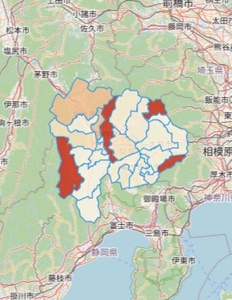
Anyway, there is no point in just complaining about the current situation, so I decided to start with what can be done now. As a first step, I created a simple website that visualizes last year’s real estate transaction data on a map.
https://minfudo.kohei-kevin.com/